Business
The Consolidation Paradox
Why Health Insurers Let Independent Practices Fail, Even When They Cost Payers Less
Executive Summary
At first glance it looks like a contradiction. An independent “mom-and-pop” healthcare practice is usually the cheapest place for an insurer to buy care. A small group or a freestanding clinic is typically paid far less for the same service than a hospital-owned version of that same practice. So if insurers, the payers, simply wanted the lowest possible cost to pay for care, they should be the fiercest defenders of small, independent practices who charge less.
However, they are not. Payers have largely watched, and in many cases accelerated, the disappearance of cheaper independent practices. They do it by paying independent practices less than they pay hospital-owned ones, by paying them slowly and contesting their claims, and by burdening them with administrative and quality-reporting demands that small offices cannot meet.
There is a powerful reason payers should want to keep independents alive, at least on its face. When providers consolidate, network-adequacy law and accreditation turn the survivors into “must-have” partners that a health plan cannot lawfully exclude, and the health insurance plans get forced into higher rates that their acquirer contracts and charges. That is precisely what happened in Philadelphia, where health insurers testified in federal court that they would “succumb to a price increase” if smaller “mom and pop” practices folded and were assimilated by the more costly hospital systems. So why do payers not protect independent practices by offering the reimbursement increases necessary to sustain them, when doing so could spare insurers the far greater cost increases that often follow once those practices are absorbed through consolidation?
Four forces make consolidation the better bet for health insurers. While payers often face higher costs during the early phases of consolidation, they frequently realize lower costs over the long run, even as overall healthcare spending continues to rise:
The biggest payers are now the consolidators. The largest health insurers increasingly own physician practices. When an independent practice is absorbed, especially for primary care, the acquirer is often the insurer’s own provider arm, transforming what would have been an external payment into an internal transfer payment; effectively “moving money from one pocket to another”, in the proverbial sense, rather than representing a true economic loss for the payer.
Scale slashes administrative cost and unlocks programs small practices cannot run. Modern value-based contracts, including shared savings and risk-bearing arrangements, depend on scale. Small independent practices often lack the patient volume, capital, data infrastructure, and risk pools needed to manage population health effectively, while larger organizations can spread those costs across broad networks. For insurers, it is far more efficient to negotiate, credential, contract, and administer one large health system that has absorbed 200 practices than to manage relationships with 200 independent groups individually. As a result, the decline of small practices often benefits payers by shifting patients into larger, risk-bearing networks that are both administratively simpler and better aligned with value-based reimbursement models.
Risk transfer requires scale. The shift to capitation, especially in Medicare Advantage, makes a small practice an unusable partner, not a cheap one. The shift toward capitation and other risk-based payment models, particularly in Medicare Advantage, means that payer-favorable arrangements require large patient populations to spread financial risk, manage care effectively, and produce predictable outcomes. As small practices struggle or fail, patients are increasingly absorbed into larger health systems that are equipped to operate these models which are more attractive partners for health insurers.
The higher rate a consolidated provider commands is the entry price, not the long-run price. Following consolidation, reimbursement rates frequently rise as services migrate into hospital-based billing structures and benefit from regulatory and reimbursement advantages unavailable to independent practices. However, much of this increase reflects a government payment and site-of-service quirk rather than a true increase in the underlying cost of care. Just as importantly, provider contracts are not perpetual. Initial rate increases become the starting point for future negotiations, where insurers can leverage network design, patient volume, value-based arrangements, utilization controls, and competitive pressures to moderate and adjust reimbursement downward over certain service lines over time. As a result, the price increase associated with consolidation is often front-loaded, while the administrative efficiencies, risk transfer, level setting of rates across the enterprise, and care-management advantages can persist for years and outweigh early price increases.
These four advantages begin to erode only when a consolidating health system becomes so large that an insurer can no longer realistically exclude it from the network: that is, when the system achieves monopoly or oligopoly status within a market. At that point, network adequacy requirements and patient demand transform the provider into a "must-have" asset, giving it the pricing leverage described by Philadelphia's insurers back to the providers and integrated system. By then, however, many vertically integrated payers have already positioned themselves on the other side of the table by acquiring physician groups and care-delivery assets of their own. The struggling independent practice is not the payer's adversary; it is often the payer's future acquisition target, referral base, or provider inventory.
Two additional observations complete the picture. First, in many specialty markets the consolidator is not the insurer at all, or even a hospital system, but private equity. Independent physician groups are frequently rolled up into larger platforms, operationally scaled, and ultimately sold to health systems or insurers: a "private-equity-to-payer pipeline" that allows payers to benefit from consolidation they did not have to finance themselves.
Second, the long-term trajectory is difficult to ignore. If the economic forces described in this paper continue unchecked, the United States could eventually be served by only a few hundred truly independent health systems, with an increasing share of physician practices, outpatient facilities, and care-delivery assets owned directly or indirectly by insurers. The remainder of this paper explores that thesis and concludes with a practical framework for how independent practices can negotiate, position themselves strategically, and advocate for policies that improve their odds of survival.
A word on what this paper claims, and what it does not. The strongest version of the argument is a market-structure and incentive analysis: under today’s payment, regulatory, and ownership environment, allowing independent practices to fail is often rational for certain payers, even when those practices are cheaper on a fee-for-service basis. That claim is well supported. A stronger claim, that payers consciously and deliberately engineer consolidation as a coordinated long-run strategy, is not one this paper sets out to prove; the reader should treat the “time arbitrage” framing in Section VIII as a strategic interpretation of the evidence rather than a demonstrated motive. The distinction matters, because the incentives are real and largely sufficient on their own, and the force of the analysis does not depend on attributing intent.
I. The Philadelphia Cautionary Tale
Philadelphia is one of the most consolidated health care markets in the country. Over three decades, a fragmented landscape of independent hospitals and physician practices collapsed into a handful of large systems, including Penn Medicine, Jefferson Health, and Temple Health, alongside a single dominant commercial insurer, Independence Blue Cross. Independent practices and standalone hospitals did not thrive there. They closed, merged, or were absorbed. In 2019, Hahnemann University Hospital, a major teaching and safety-net hospital, shut its doors entirely after a private-equity-linked owner concluded its real estate was worth more than the hospital.[1]
The decisive moment came in 2020, when Jefferson Health agreed to acquire the Albert Einstein Healthcare Network. The Federal Trade Commission (FTC), the agency that polices anticompetitive mergers, sued to block the deal, arguing that combining the two systems would leave too few competitors in parts of Philadelphia and let the merged system raise the prices it charged health insurers.[2] To prove the point, the FTC put the insurers themselves on the stand. Executives from Independence Blue Cross and Cigna testified that, if the merger went through, they would “succumb to a price increase.”[3]
That testimony is the whole argument in a sentence: the carriers were telling a federal judge, under oath, that healthcare practice consolidation had advanced so far that they no longer had the leverage to say no to price increases from the very health systems they allowed to consolidate all the independent practices. The judge was skeptical of the payer’s motives for blocking the merger, noting that Independence had its own reasons to oppose a system that might one day compete with it in health insurance, and he allowed the merger to proceed. The FTC dropped its appeal against the merger in 2021.[4] But the admission stands: in a market that has already consolidated, the payer pays what the system demands when consolidation reached oligopoly status.
Run the tape backward and the lesson for the rest of the country comes into focus. Every independent practice a payer pays less to, pays more slowly, and burdens with friction for payment is a practice that may not survive on its own. When it fails, it does not vanish. It is absorbed into one of the large systems. Each absorption makes that system a little larger, a little more essential to the insurer’s network, and a little more able to set price.
This raises the question this paper exists to answer. If consolidation of “mom and pop” independent healthcare practices ultimately forces insurers to pay more, because the sheer weight of a large system leaves them no room to say no, then why do the health insurers not learn from Philadelphia and protect the independent practices whose survival would have spared them that leverage and allowed them to continue paying less? Why feed the very dynamic that ends with health insurers ultimately succumbing to higher rates in the short and long-run?
The sections that follow answer it. Four major forces explain why payers drive consolidation anyway, and how they so often still pay less. A final section returns to the mechanism behind the Philadelphia testimony, the legal machinery that makes a large enough system impossible to refuse, and where health insurance companies still hold strategic power in preventing consolidation past it’s marginal cost breaking point.
II. The Apparent Paradox, Stated Directly
Under fee-for-service, which is the traditional arrangement in which a payer pays a set price for each individual service a healthcare entity charges, the same service costs the payer different amounts depending on who owns the practice. Care in an independent non-hospital affiliated office is generally cheapest. The identical care in a hospital-owned practice is generally more expensive, often dramatically so, for reasons explained in Section VI. On average, commercial insurers pay hospitals roughly 50% above the cost of providing the care, far above what Medicare pays, and prices for the same service can vary by more than 300% within a single market.[5]
So the “prima facie model”, or the one that deceptively appears straightforward on its face, says payers should love independents and fear consolidation. And payers do say, loudly, that consolidation raises prices; it is the centerpiece of their lobbying[6]. Yet their behavior in the market frequently accelerates that consolidation. Resolving the contradiction means seeing what the prima facie model misses: four forces that make consolidation the better bet for a payer in the medium to long-run, and a catch that explains why, once consolidation has gone far enough, the bet can turn against payers unless they act to prevent the ‘consolidation tipping point’.
A necessary distinction: which payers?
Before turning to the forces, one distinction has to come first, because it governs everything that follows: the incentive to tolerate consolidation is not uniform across payers. It is strongest where a payer can internalize provider margin, bear and manage risk at scale, and influence where patients are referred. It is weakest where a payer mainly administers benefits and owns few provider assets. In rough order of exposure:
Vertically integrated national payers (UnitedHealth’s Optum, CVS’s Aetna, Humana, Elevance) own physician and care-delivery assets and run large Medicare Advantage books. For them, a payment to an owned practice is an internal transfer, and the four forces below apply with full force.
Medicare Advantage-heavy payers depend on large, risk-bearing provider partners and are pulled toward scale even where they own less directly.
Regional Blue Cross plans and pure insurers that own no provider arm have the opposite incentive. They must pay the higher post-consolidation rates and capture none of the provider margin, which is why they are often the most aggressive advocates for site-neutral payment and the most willing to challenge hospital mergers (Section IX).
Administrative-services-only (ASO) and self-insured commercial arrangements place much of the cost risk on the employer, so the insurer’s incentive here is weaker and more administrative.
Medicaid managed-care plans operate under distinct rate-setting and adequacy constraints that blunt the dynamic further.
So when this paper says “payers,” it is describing a tendency sharpest for the vertically integrated, Medicare-Advantage-heavy national players, one that fades toward the pure-insurance and benefits-administration end of the spectrum. That qualification is not a hedge bolted on at the end; it is part of the thesis, and it is why the paper returns repeatedly to who owns the providers.
III. Force One: The Biggest Payers Are Now the Consolidators
This is the most important point, and it dissolves most of the paradox. The largest health insurers are no longer just insurers. They have bought their way into owning the providers too.
This is vertical integration: one owner combining different stages of the supply chain. (Combining competitors doing the same service(s) at the same stage, such as two hospitals merging, is horizontal integration.) The scale is striking:
Insurer parent | Provider / services arm | Scale and notable assets |
|---|---|---|
UnitedHealth Group | Optum | About 90,000 employed or affiliated physicians, roughly 1 in 10 U.S. doctors, more than any hospital system. |
CVS Health (owns Aetna) | Oak Street Health; Signify Health | About $10.6B for Oak Street (senior primary care) and about $8B for Signify (home-based care), both 2023. |
Humana | CenterWell / Conviva | Largest senior-focused primary care operator in the U.S.; roughly 300 centers serving about 318,000 seniors. |
Elevance Health | Carelon | Care-delivery and services arm; primary-care ventures (apree health, Millennium Physician Group) serving close to 1 million patients. |
Sources: AHA (2025); CVS Health Form 8-K (2023); Humana / Medical Economics; Darwin Research Group.
These insurer owned provider and healthcare entity holding arms are vast. Optum alone employs or is affiliated with about 90,000 physicians, roughly one in ten U.S. doctors, more than any hospital system.[7] Over a recent five-year window, commercial insurers acquired about 40% more physicians than hospitals did.[8]
Here is why this dynamic matters. When a small practice is squeezed into distress and acquired, a meaningful share of the time the acquirer is the payer itself, or a private-equity group the payer will later contract with. The high commercial rate the practice now commands is no longer money the payer loses to an outside provider. It moves from the insurance side of the company to the provider side of the same company. In accounting terms it stops being a cost paid out and becomes an internal transfer price. The parent is paying itself, and the provider margin that once belonged to an independent doctor now belongs to the payer’s own subsidiary.
The payer’s goal, then, was never to keep practices independent. It was to be the one holding the practice when independence becomes untenable. Government reviewers have found far less hard evidence on how insurer ownership of physicians affects prices than on hospital ownership, partly because these transfers happen inside a single company.[9] There is also evidence that some insurers structure these purchases to help satisfy their medical loss ratio, the rule requiring them to spend a minimum share of premiums on care, by routing that spending to their own subsidiaries.[10]
A. Why the strategy concentrates on primary care
Look again at the table and a pattern jumps out: CVS bought Oak Street, Humana built CenterWell, and Elevance assembled Carelon, and all three are primary care. That is not an accident. Payers buy primary care because the primary care physician is the front door to everything else.
The primary care physician controls referrals, anchors the patient relationship, and, under Medicare Advantage, generates the risk scores and quality measures that drive the plan’s revenue. Owning that physician lets a payer steer where patients go next, document the diagnoses that raise MA payments, and run the population-health programs that capitation rewards. A primary care visit is cheap; what it controls is expensive. CVS paid about $10.6 billion for Oak Street and about $8 billion for Signify on exactly this logic[11]; Humana’s CenterWell is the nation’s largest senior primary care operator[12]; and Elevance’s Carelon serves close to a million primary-care patients.[13]
For most specialty care, payers have historically preferred a different tool. Rather than own the cardiologist or the oncologist, they manage the specialist from the outside, through prior authorization, benefit-management subsidiaries (Elevance’s Carelon Medical Benefits Management is a large example), and steerage. Specialty care is high-cost and episodic; owning it brings risk and overhead without the front-door control that makes primary care so valuable. So the natural assumption, that if payers consolidate primary care they must be consolidating specialty too, does not hold uniformly. It holds where, and only where, the economics line up.
B. Do insurers consolidate specialty care?
The honest answer is: yes, but unevenly, and mostly by one company at this current moment in time. Among insurers, specialty consolidation is largely an Optum story, and within that, an ambulatory-surgery-center story.
The economics line up in one place above all: procedures that can be moved out of the hospital into a lower-cost ambulatory surgery center (ASC) that the payer owns. There, owning the site captures the site-of-service savings directly. That is exactly where UnitedHealth’s Optum has built its specialty footprint. Through SCA Health, which it bought in 2017 for about $2.3 billion, Optum runs on the order of 370 to 420 ambulatory surgery centers across 35 states, performing more than a million procedures a year on about $5 billion in revenue, one of the largest ASC operators in the country. SCA rebranded itself “the future of specialty care,” and Optum built an Optum Specialty Practices model around procedural specialists. Its recent deals are explicit: SCA acquired the orthopedic platform OrthoAlliance in 2024, and in 2025 Optum bought U.S. Digestive Health, the largest gastroenterology group in the Philadelphia region, and bid for the national ASC operator Surgery Partners.[14]
The other large payers have mostly stayed out of specialty ownership. CVS, Humana, and Elevance concentrated their acquired assets in primary care, home health, and behavioral health[15]. So among insurers, specialty consolidation is real but narrow: Optum, and procedural specialties that fit the surgery-center model.
Then, the question turns to: who is consolidating the rest of specialty care? The answer is two players the independent specialist meets long before any insurer does: private equity and hospitals.
Specialty | Consolidation signal | Leading consolidator(s) |
|---|---|---|
Dermatology | 34% of all PE physician-practice deals (2012–2021); about 50% mean local PE share where present. | Private equity |
Ophthalmology | 25% of all PE deals; about 45% mean local share where present. | Private equity |
Gastroenterology | 11% of PE deals; local penetration rose from 7.6% to 13.1%. | PE; Optum (U.S. Digestive Health, 2025) |
Orthopedics | About 54% mean local PE share where present. | PE; Optum / SCA (OrthoAlliance, 2024) |
Oncology | Hospital acquisitions nearly tripled (2010–2020); 82 PE firms bought 423 practices (2013–2022). | Hospitals; private equity (e.g., OneOncology) |
Cardiology | Only about 31% of cardiologists still in private practice (2024), the lowest of any major specialty. | Hospitals (employment) |
Urology | Local PE penetration rose from 4.4% to 9.0%. | Private equity |
Sources: Health Affairs (2024); American Antitrust Institute / UC-Berkeley (2024); AMA (2025); Community Oncology Alliance (2020); Int. J. Radiation Oncology (2025).
Private equity is now the dominant consolidator of office-based specialty practice. About 6.5% of all U.S. physicians worked in PE-owned practices by 2024, up from 4.5% in 2022 (a roughly 44% relative increase in just two years), but that national average badly understates the concentration, because PE buys by specialty and by local market. A Health Affairs analysis of acquisitions from 2012 to 2021 found dermatology accounted for 34% of all PE physician-practice deals, ophthalmology 25%, and gastroenterology 11%, with local penetration climbing fast (gastroenterology nearly doubled, from 7.6% to 13.1% of physicians in the markets studied, a roughly 72% relative increase over the period). By the end of that period, PE firms collectively held more than 30% of at least one specialty in 120 of 384 metropolitan markets, and more than 50% in sixty of them.[16] Where PE is present at all, its mean local market share runs roughly 45% to 54% across orthopedics, dermatology, radiology, gastroenterology, OB/GYN, ophthalmology, and cardiology.[17] These are not small numbers. The percentages reflect shifting dynamics in who owns and manages the specialty groups that fail to remain independent, with private equity now a dominant acquiring force. Moreover, these are targeted acquisitions of high delta and feeder services along the value chain (e.g., gastroenterology feeds into medical and surgical oncology specialties through colonoscopy screenings). We will see later how this roll-up approach benefits payers in the long-run.
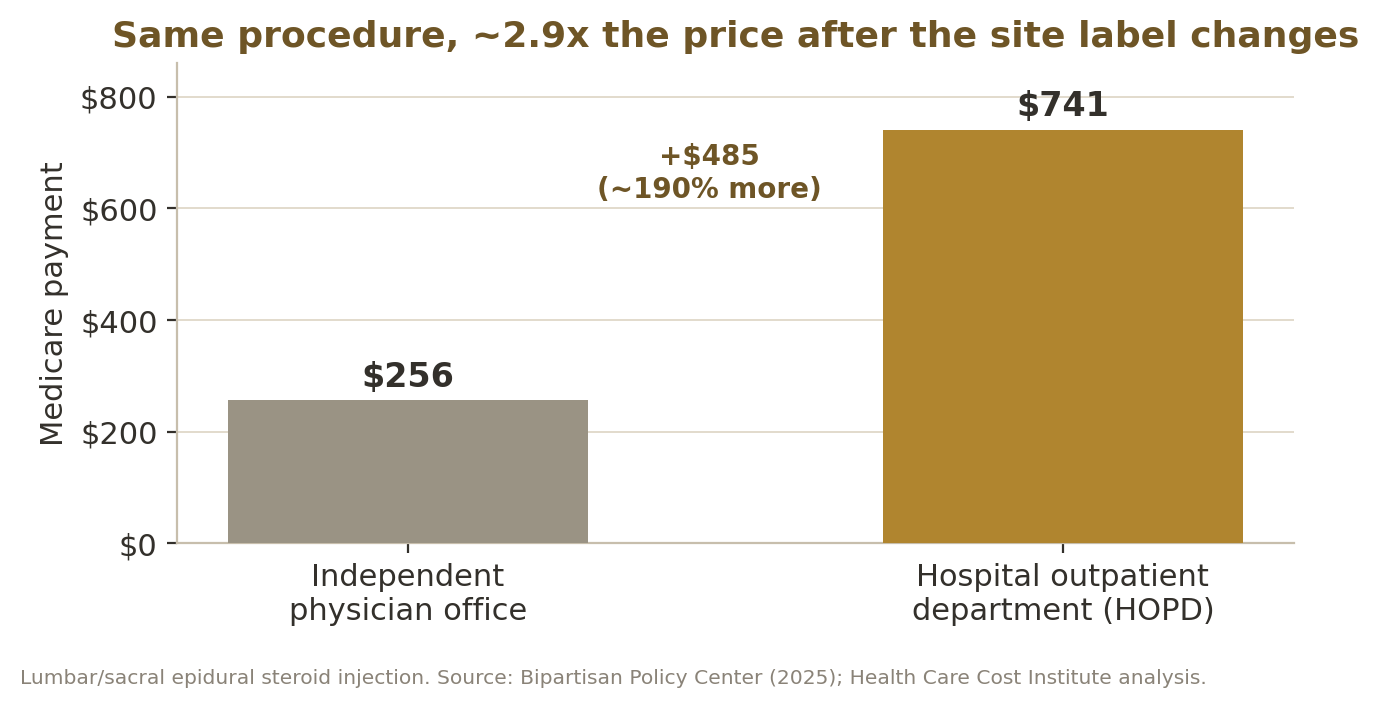
Figure 1. Private equity does not buy at random; it concentrates by specialty. Three fields accounted for roughly 70% of all PE physician-practice deals from 2012 to 2021. Source: Health Affairs analysis (2012–2021).
Hospitals, too, consolidate the specialties that fit their facility-fee economics, cardiology above all. After Medicare payment changes made hospital-based cardiology far more lucrative than the office-based version, practices moved en masse. By 2024, only about 31% of cardiologists still practiced independently, the lowest share of any major specialty. Across all specialties, the share of physicians in private practice fell to about 42% in 2024, down from 60% in 2012, a relative decline of nearly one-third in barely a decade.[18]
Put the three together and the specialty picture is a vise, not a single hand. The independent specialist is squeezed by private-equity roll-ups, by hospital employment, and, in procedural fields, by Optum’s surgery-center platform. One blunt data point ties it together: by 2024, all ten of the largest U.S. health insurers had acquired physician practices or the management companies that run them.[19]
C. The private-equity-to-payer pipeline, and the expensive specialties
There is a second layer that explains why insurers can afford to let even expensive independent specialists fail: they rarely have to do the consolidating themselves. Private equity does it for them. Researchers now describe a private-equity-to-payer pipeline: PE firms buy and roll up fragmented independent specialists, build a regional platform with borrowed capital, then sell that platform to a strategic consolidator, often a payer.[20] The gastroenterology examples are clean. Kelso-backed Capital Digestive Care was sold to Optum’s SCA Health in 2022. Amulet Capital assembled U.S. Digestive Health in 2019 out of three regional groups, grew it to roughly 149 physicians and 24 surgery centers, and sold it to Optum in 2025. PE owners typically aim to exit within about seven years, and the natural buyer at the end is a strategic with the scale to run it.
Insurers and private equity are not only sequential; they co-invest. Humana built CenterWell through joint ventures with the PE firm Welsh, Carson, Anderson & Stowe, and Elevance built its Carelon primary-care venture with Clayton, Dubilier & Rice.[21] The line between “insurer-owned” and “PE-owned” is blurring.
This pipeline is why a payer can rationally let even the most expensive independent specialties collapse. Take the high-cost and consequently high-revenue generating specialties (cardiology, oncology, neurology, gastroenterology, orthopedics), and oncology in particular, the highest-drug-cost field of all. Independent community oncology has been collapsing for years. Hospital acquisitions of community oncology practices nearly tripled from 2010 to 2020, drawn by facility fees and the 340B drug discount, a federal program that lets qualifying hospitals buy outpatient drugs cheaply while billing payers at full price (hospitals’ per-unit prices for the top infused cancer drugs run on the order of 86% above physician-office prices). Private equity moved in as the alternative aggregator: 82 firms acquired 423 oncology practices from 2013 to 2022, a pattern associated with about 5.3% higher office-visit prices and a roughly 50% jump in radiation-therapy spending, culminating in a private-equity group’s $2.1 billion acquisition of OneOncology, the largest independent community oncology network.[22] The pattern continued in 2025, when McKesson, the drug distributor that had bought the US Oncology Network in 2010, acquired a controlling 70% interest in Core Ventures, the management services organization (MSO) of Florida Cancer Specialists & Research Institute, for roughly $2.5 billion, folding the nation’s largest independent oncology practice into that network (now about 3,300 providers); notably, McKesson purchased the practice’s business and administrative arm rather than its clinical assets.[23]
For the payer, the calculus differs by who ends up owning the specialty, and that nuance matters. Hospital capture of oncology is the worst outcome, because facility fees and 340B inflate exactly the drug spend the payer covers; that is why pure insurers push hardest for site-neutral and 340B reform. But where the payer can own the procedural site (Optum’s surgery centers) or manage the specialty from the outside (prior authorization and benefit-management subsidiaries or primary care gatekeeping), the high cost of a specialty is a reason to control it, not to preserve a fragmented independent landscape it cannot manage. Either way, the independent specialist’s survival is not the payer’s priority. The expensive independent practice is left to fail, be rolled up by private equity, or be absorbed by a hospital, and the payer engages with whatever consolidated entity remains, often one that private equity built and handed over.
IV. Force Two: Scale Slashes Administrative Cost
Set ownership aside, and dealing with many small practices is still expensive for a health insurance company. Negotiating contracts, credentialing (verifying qualifications), connecting billing systems, managing networks, auditing, and quality reporting, all done against 200 separate practices, costs an order of magnitude more than doing it once with a single 200-physician system. Each independent is its own counterparty, with its own contract, tax ID, and software. Payers can reduce these variable costs by reducing the variables: allow independents to fold under one system.
More importantly, the programs payers increasingly want to run do not function at small scale, which also makes consolidation attractive to payers. Two common examples:
Accountable Care Organization (ACO): a group of providers held jointly responsible for the cost and quality of a population, sharing in the savings if it keeps spending down.
Bundled payment: a single fixed amount for an entire episode of care, say a knee replacement and everything related to it, rather than a fee for each piece.
Both require shared data infrastructure and a patient population large enough for the statistics to mean something. The fixed cost of running such a program with a five-doctor practice is, in certain ways, the same as running it with a 500-doctor system, but only the large system generates enough attributed patients to make the results reliable and the overhead worthwhile. Payers do not want 8,000 micro-contracts. They want 40 system-level contracts with enough scale to matter.
V. Force Three: Risk Transfer Requires Scale (the Medicare Advantage Engine)
This force draws the least public attention and may matter the most.
The whole industry is shifting from fee-for-service toward capitation. Instead of paying per service, the payer pays a fixed amount per member per month; the provider keeps whatever is left if care costs less, and absorbs the loss if it costs more. This is risk transfer: the financial risk of a patient’s health moves from the payer to the provider.
You cannot hand that risk to a five-physician practice. A small group cannot absorb the statistical swings (a few catastrophically sick patients would bankrupt it), cannot manage population health at scale, and cannot build the data systems required. For Medicare, regulators will not even let a payer delegate that risk to an entity too small to bear it.[24]
This matters because of Medicare Advantage (MA), where the government pays a private insurer a fixed monthly amount to cover a senior’s care instead of paying providers directly. MA is now the majority of Medicare: in 2025, 54% of eligible beneficiaries, about 34 million of roughly 63 million people, were enrolled, and the Congressional Budget Office (CBO) projects 64% by 2034.[25] It is also the highest-margin business for most national payers, estimated to cost the government about 20% more per enrollee than traditional Medicare would for comparable people, roughly $84 billion in 2025 alone.[26] Enrollment is concentrated: UnitedHealth Group and Humana together hold about 46% of all MA enrollees.[27]
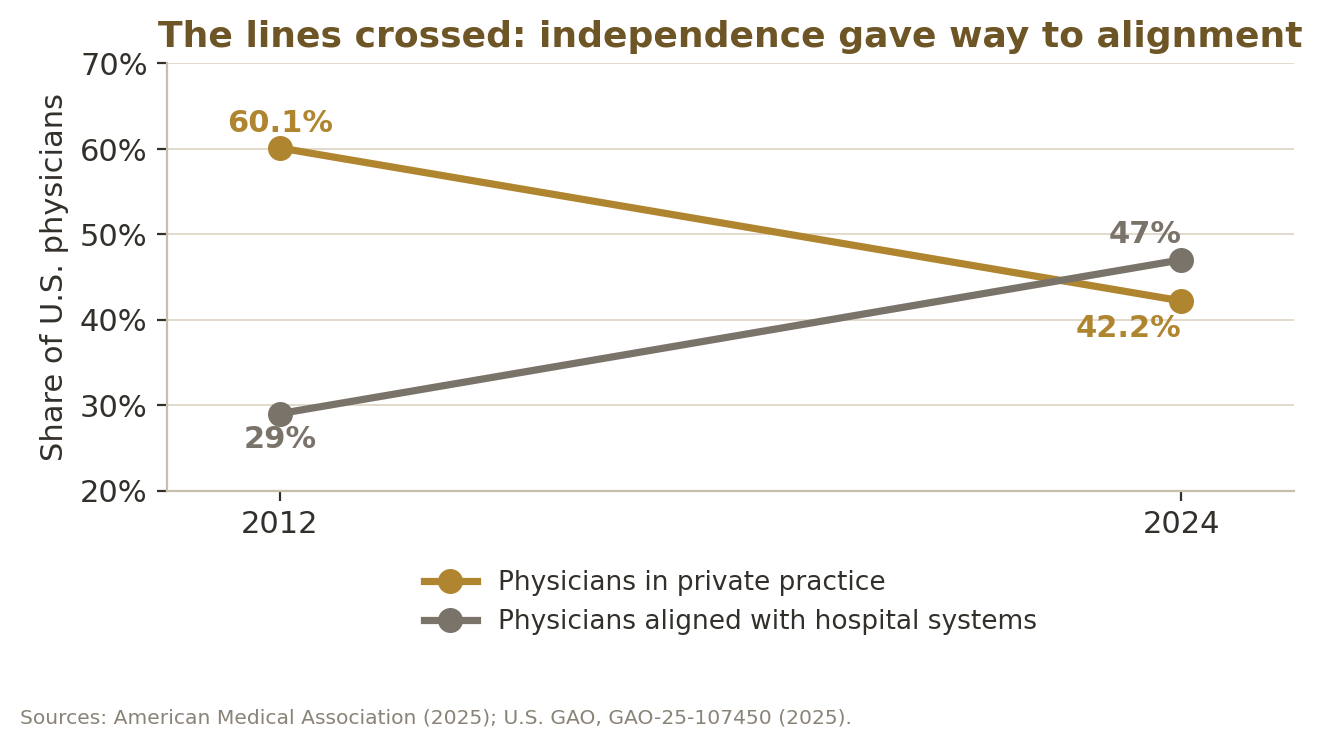
Figure 2. Medicare Advantage, the capitation engine that makes scale indispensable, is now the majority of Medicare and is projected to keep climbing. Source: KFF (2025); CBO.
An MA insurer’s economic model depends on large, integrated, risk-bearing provider partners to capitate. From that angle, a small independent practice is not a cheap asset. It is an unusable one, because it cannot participate in the contract structure that produces the payer’s MA profit, where increasingly more patients are moving as the baby-boomer generation continues to age[28]. The payer would far rather have one large system it can hand global risk to than a constellation of independents it can only pay one service at a time.
VI. Force Four: The Higher Rate Is the Entry Price, Not the Long-Run Price
Consolidated providers do get paid more, the prima facie model’s strongest fact. But two things complicate it. A large part of the increase is a government billing quirk, not a free choice by commercial payers. And payers have tools to recover much of the rest over time.
A. The billing quirk
The clearest reason the same care costs more after acquisition is a billing rule. Medicare, and most commercial insurers following its lead, pays more for a service in a hospital outpatient department (HOPD) than for the identical service in an independent office. The extra charge is a facility fee, meant to offset hospitals’ higher overhead. When a hospital buys an independent clinic, it can often re-bill that clinic as an HOPD and collect the facility fee on top of the same doctor’s same work in the same room. The differential is large:
Service or measure | Independent office | Hospital outpatient dept. |
|---|---|---|
Epidural steroid injection, lumbar/sacral (Medicare) | About $256 | About $741 |
Typical Medicare differential across many identical outpatient procedures | 1x (reference) | 2x to 4x higher |
Average commercial price change after a hospital acquires the practice | (baseline) | About +14% (roughly half purely from re-billing as an HOPD) |
Sources: Bipartisan Policy Center (2025); Health Care Cost Institute analysis (PMC); Capps, Dranove & Ody (2018).
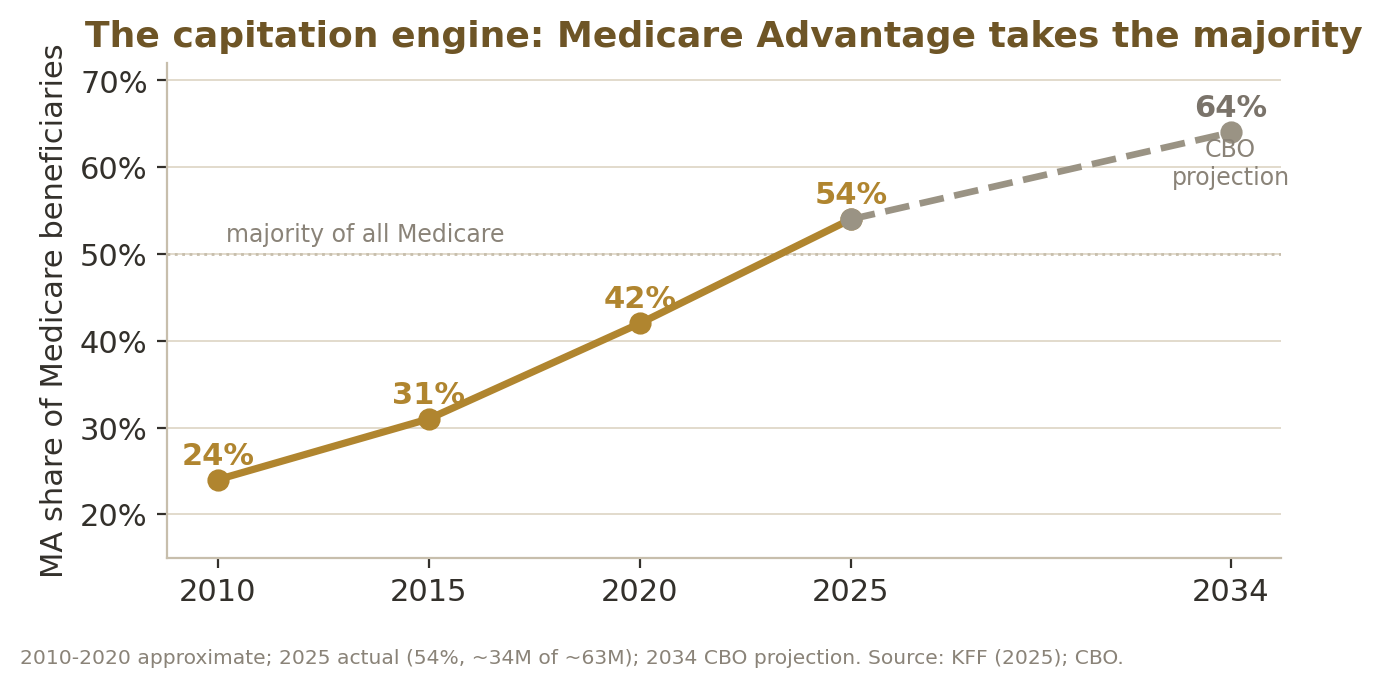
Figure 3. The billing quirk in one picture: the same lumbar epidural injection costs Medicare nearly three times as much once the office is re-labeled a hospital outpatient department. Source: Bipartisan Policy Center (2025); Health Care Cost Institute.
Medicare pays two to four times more for many identical outpatient procedures in a HOPD than in a physician office.[29] The research bears this out. After a hospital acquires a practice, prices for its services rise about 14% on average, and nearly half of that increase comes purely from the change in billing rules, not from any change in care.[30] Federal data show vertical hospital-physician integration raising physician-service prices about 14%, while horizontal hospital mergers in concentrated markets raise prices anywhere from 6% to 65%.[31] One study found office-visit prices rose 17% after consolidation; another found childbirth prices rose 15% after OB/GYN practices were absorbed.[32]
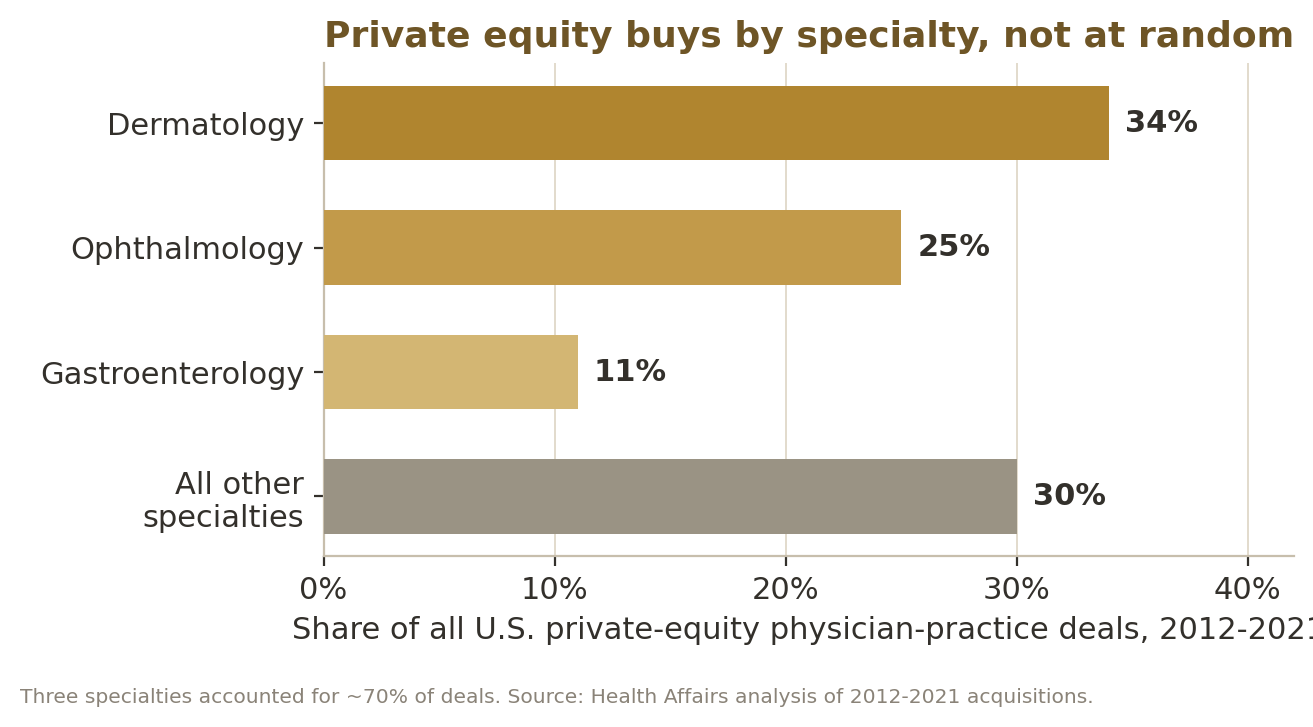
Figure 4. Across multiple studies, the same care costs measurably more once a hospital owns the practice. Source: Capps, Dranove & Ody, J. Health Economics (2018); U.S. GAO (2025).
Because the biggest, cleanest piece of this is a CMS rule rather than a commercial choice, commercial payers get dragged along by it. That is why many of them lobby for site-neutral payment, paying the same amount for the same service regardless of setting (e.g., a HOPD or a freestanding independent physician office outpatient facility). CBO estimates that fully equalizing these payments could save more than $157 billion over a decade, and CMS began a modest version for certain drug-administration services in 2026.[33]
B. The clawback toolkit, and its limit
Despite the dynamics described in the previous section, consolidation's impact on payer costs is often front-loaded. Hospitals, health systems, and private-equity-backed acquirers may secure higher reimbursement rates at the outset, increasing payer expenditures in the near term. Yet those gains rarely occur in a vacuum. Payers retain a robust toolkit of contractual and network-management mechanisms that allow them to recapture or redistribute much of those increased expenditures over the life of the agreement: narrow networks (covering only a limited set of providers and excluding expensive systems), reference pricing (capping plan payments and shifting the difference to patients), steerage (using benefit design to direct patients toward lower-cost providers), and direct physician employment (if the payer owns the physician, it is no longer negotiating with an independent counterparty[34]).
More fundamentally, rate is only one line in a multi-line contract, and sophisticated payers negotiate the entire agreement rather than any single service. A health system may win substantial increases in one service line, only to see those gains offset over time by lower rates, utilization controls, prior-authorization requirements, site-of-care restrictions, or adverse adjustments elsewhere in the contract. The result resembles pressing one end of a balloon: revenue expands in one area but contracts in another, while the total economic value transferred under the agreement changes far less than the headline rate increase might suggest. The payer is not merely negotiating prices; it is continuously reallocating where and how healthcare dollars flow across the contract.
The limit on that toolkit is the Philadelphia lesson, and it points to the catch examined in the next section: the tools work only until the provider grows too big to exclude. Analysis of newly public price data confirms that an insurer’s usual ability to negotiate lower prices erodes as the hospital market becomes more concentrated, and past a certain point, the leverage flips.[35]
VII. The Catch: Why a Consolidated System Can Force Payers to Pay More
The four forces work well to explain why payers drive consolidation and how they so often still pay less. This section is the limit on all of it. The clawback toolkit works only until a provider grows too big to exclude, and “too big to exclude” is usually not a commercial judgment at all. It is a legal and accreditation requirement, and that requirement hands the largest systems hard pricing leverage.
A. What the rules require
To sell a health plan, a health insurer cannot simply contract with whoever is cheapest. Its network must be “adequate” under federal and state rules[36]. For Medicare Advantage, the governing regulation (42 C.F.R. § 422.116) requires a plan to contract with a minimum number of each type of provider and facility, close enough that at least 90% of enrollees in a county can reach covered services within set travel-time and distance limits. The standards vary by county and specialty, and since contract year 2024 a plan applying to enter or expand a service area must prove it meets them. CMS can deny the application if the network has gaps.[37] The rules go further for hospitals: to count a hospital in its network, the plan must also contract with the anesthesiology, emergency-medicine, pathology, and radiology groups that staff it.[38]
Commercial and marketplace plans face parallel demands through accreditation. Plans sold on the Affordable Care Act marketplaces must hold recognized accreditation, and accreditation from the National Committee for Quality Assurance (NCQA) is widely required. By NCQA’s account, 43 states rely on its accreditation and 26 mandate it for Medicaid managed care, and plans covering roughly 169 million Americans, about 72% of insured people, are NCQA-accredited. Its standards include a dedicated Network Management category that evaluates whether members can actually reach care.[39]
B. The must-have provider
Now combine those rules with consolidation. When a single large system owns the only hospitals, or the dominant supply of specialists, within the radius the rules require, the payer’s plan cannot assemble a compliant, sellable, accreditable network without contracting that system. Excluding it is not merely painful; it can make the plan unlawful to offer or impossible to accredit in that market. Economists call such a provider a must-have provider, and the data show how common this has become: as of 2021, health systems controlled about 93% of acute-care hospital beds in the United States. A provider an insurer cannot say no to does not need to negotiate. The mega-consolidated hospital system sets a price the health insurer must accept.[40] This is exactly the type of cartel or monopoly leveraging dynamics antitrust statutes aim to prevent. [41]
Nonetheless, this description is the legal machinery behind the Philadelphia testimony. When Independence Blue Cross and Cigna told the court they would “succumb to a price increase,” they were describing exactly this: a network they were obligated to keep adequate, anchored by systems they could not lawfully or practically drop. Network-adequacy law, written to protect patients’ access to care, has the side effect of guaranteeing the largest systems a seat at the table and the pricing power that comes with it. It is precisely the fate that befalls a payer that does nothing but pay independents less, and never moves to own the survivors. The verticalized payers learned to be on the other side of it.
VIII. The Unifying Model: Time Arbitrage on Practice Valuations
Put the four forces and the ‘must-have-provider’ catch together and the payer’s behavior is not self-defeating. It can be read as a sequence that arbitrages the value of practices across time (i.e., capturing value by exploiting a pricing mismatch that exists at different points in time):
Pay independent practices less. Hold their fee-for-service rates below the hospital-owned equivalent, and add denial friction (the cost and delay of prior authorization and claim denials, which falls hardest on small offices without administrative staff) plus quality-reporting demands they cannot operationalize.
Drive down valuations. Distressed, exhausted independents become cheap to buy.
Let consolidation happen, or do it yourself. A fraction give up independence. Increasingly the buyer is the payer’s own provider arm, or a private-equity firm that will later flip the platform to a payer; sometimes it is a hospital.
Reset the economics on the back end. Through internal transfer pricing (when the payer owns the practice), capitated risk contracts, narrow networks, and patient steerage, payers can often reclaim much of what they appear to concede in headline reimbursement rates. These tools operate within a network structure that may ultimately render the consolidated health system a must-have provider, yet still allow the insurer to shape where and how revenue is earned. Only when consolidation reaches a true tipping point, where a health system acquires monopoly or oligopoly power and can no longer credibly be excluded from the network, does the payer begin to lose its ability to contain costs on its preferred terms.
In this framing, the high rate a consolidated entity nominally commands is simply the entry price, what it costs to gain access to the new arrangement. The long-run economics are governed by network leverage, ownership structures, transfer pricing, and risk-sharing terms that did not exist when the practice was independent. The payer is not necessarily trying to avoid the higher sticker price. It is trying to be on the right side of it in the long-run.
This answers the Philadelphia question directly. Philadelphia shows what happens to a payer that consolidates providers but does not own them: it eventually finds itself testifying in court that it must succumb to their bargaining power. The national, vertically integrated payers learned the opposite lesson. They run the other play. By owning providers, they position themselves so that when the must-have leverage described in Section VII arrives, it works for them rather than against them.
Yet strategic ownership is not the only force pushing in this direction. Even if one rejects the argument that payers consciously tolerate consolidation because they expect to capture its benefits later, a second explanation remains: the incentives facing health insurers are often poorly aligned with preventing long-term provider concentration.
Most large insurers are publicly traded corporations or are managed by executives whose compensation, performance evaluations, and career advancement depend heavily on annual or even quarterly financial performance[42]. As a result, the decision-making horizon of the organization is frequently much shorter than the time horizon over which consolidation's most significant competitive consequences emerge. Viewed through that lens, permitting or even facilitating consolidation can be entirely rational. Acquiring physician practices, narrowing networks, steering patients, renegotiating contracts, and capturing referral flows may generate measurable savings and earnings improvements today in the short-run, even if those same strategies contribute to greater provider concentration years later.
The executive who delivers this quarter's earnings target, improves the medical loss ratio, or increases shareholder returns receives the benefit immediately. The consequences of a future market in which a handful of dominant health systems possess overwhelming negotiating leverage may not materialize for five, ten, or fifteen years. By then, the responsible executives may have retired, changed companies, or moved into different roles. In that sense, consolidation may reflect not merely a market failure but an incentive-horizon mismatch: the long-term risks are borne by the future organization, while the short-term gains accrue to the current one.
Indeed, the two explanations are not mutually exclusive. Strategic vertical integration and short-term financial incentives point in the same direction. In some cases, payers may reasonably expect to capture the benefits of consolidation through ownership and contracting structures. In others, they may simply be responding to incentives that reward near-term financial performance while discounting distant competitive risks. Either way, the result is the same: consolidation proceeds.
This dynamic helps explain why the cycle can continue even when sophisticated market participants recognize its potential downside end state. The relevant question for many decision-makers is not whether provider consolidation could eventually erode payer leverage, but whether permitting consolidation advances present financial objectives. So long as the answer remains yes, the future risk of monopoly, oligopoly, or unfavorable contracting dynamics can be treated as acceptable, discountable, or simply someone else's problem to solve. Regardless, the four forces describe here still provide strategic rationale for why consolidation in the long-run still works to a payer’s advantage even if there is the ‘tipping point’ consolidation risk. Yet, we will discuss later how payers have a strategy for this as well.
What the evidence shows, and what it infers
Because the policy and competitive stakes are high, it is worth separating the empirics from the interpretation laid over them. The following are well established in the literature: provider consolidation raises prices; vertical hospital-physician integration raises physician-service prices and is increasing; risk-based payment models favor scale; and private equity and hospital systems are rapidly reshaping specialty practice, with the share of physicians in independent practice falling to roughly 42% in 2024 from about 60% in 2012. None of that is seriously contested.
The more inferential claim is the one this paper has been building: that some payers effectively arbitrage the value of practices across time, paying independents less, letting valuations fall, and owning or contracting the survivors. I find that reading persuasive and directionally correct, but it is a strategic interpretation of the evidence, not a documented intent. A skeptical reader can accept every empirical finding above while remaining agnostic about motive, and the conclusions of this paper survive either way: whether a given payer is acting deliberately or simply responding to incentives that reward near-term performance, the market outcome is the same.
The other drivers: provider-side and policy-created causes
Two further qualifications keep the argument honest. First, payer behavior is one current in a much wider river. Independent physicians consolidate for many reasons that have little to do with insurers: clinician burnout, the absence of a successor as senior physicians retire, the capital needed to modernize, the cost and complexity of electronic health records and regulatory compliance, recruiting difficulty, malpractice exposure, and a simple need for liquidity. A complete account treats payer incentives as accelerants of a trend with deep independent roots, not as its sole cause.[43]
Second, many of the incentives described here are policy-created, not payer inventions. The hospital outpatient facility-fee differential, the 340B drug-discount program, the inflation-driven divergence between hospital outpatient and physician fee-schedule updates, Medicare Advantage risk adjustment, and network-adequacy rules are all creatures of statute and regulation. Payers respond to and benefit from them, but they did not design them. The distinction matters for remedy: it locates much of the durable fix in the rules themselves, not only in payer conduct, a theme the closing sections develop.
IX. The Exception That Proves the Rule: Regional Blues
One part of the prima facie case is correct: some payers really would be better off in a fragmented market. The clearest examples are regional Blue Cross Blue Shield plans with no Optum-style provider-ownership strategy. A pure insurer that owns no providers has everything to lose from consolidation, because it must pay the higher rates and contract the must-have systems, and nothing to gain, because it captures none of the provider margin.
That is why these plans are often the most aggressive advocates for site-neutral payment and the most willing to file antitrust objections to hospital mergers[44]. Independence Blue Cross’s posture in the Jefferson-Einstein case fits the pattern, even as the judge questioned its motives. But pure regional insurers are a shrinking minority of the commercial market, and even they cannot escape the Medicare Advantage capitation dynamic, which pushes every participant toward large, risk-bearing partners.
X. The Endgame: A Thesis on Radical Consolidation
These forces do not point toward equilibrium. They point toward continued consolidation, and they support a thesis worth stating plainly: if the dynamics persist, the United States may eventually be served by only a few hundred genuinely independent health systems, perhaps two to four hundred, within the next twenty to fifty years.
The current data do not yet show a collapse in the raw count of total healthcare systems. The Agency for Healthcare Research and Quality (AHRQ) Compendium of U.S. Health Systems has counted a remarkably stable number: about 637 in 2018, 635 in 2021, 640 in 2022, and 639 in 2023.[45] But that stable headline conceals the real movement, for three reasons.
First, the count holds steady only because small systems keep forming at the bottom even as large ones absorb hospitals and physicians at the top. The size distribution is stretching, not holding. The largest systems already exceed 10,000 hospital beds or 10,000 physicians each. As Section VII noted, systems already control about 93% of acute-care beds, and physician alignment keeps climbing: the share consolidated with hospital systems rose from under 30% in 2012 to roughly 47% by 2024, with more than half of all U.S. physicians now employed rather than independent.[46]
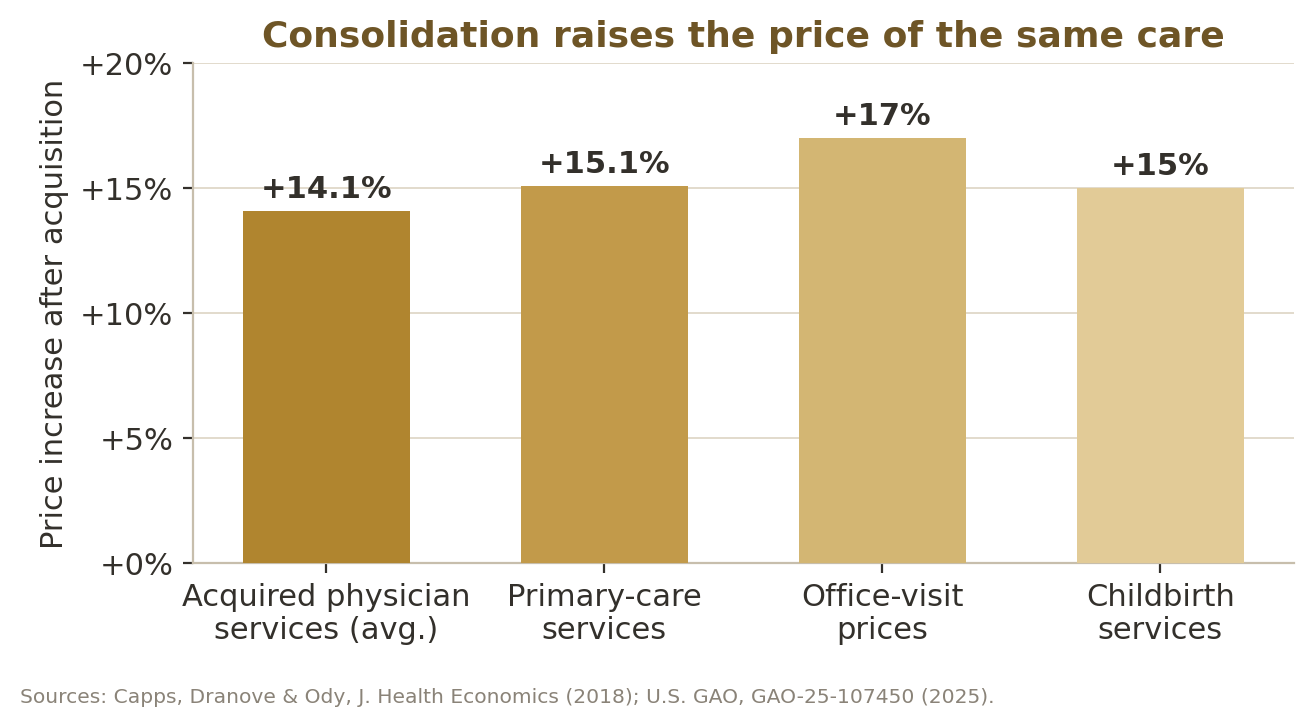
Figure 5. The stable count of “systems” hides the real movement: independent practice fell from a clear majority to a minority in barely a decade as hospital alignment rose to meet it. Source: American Medical Association (2025); U.S. GAO (2025).
Second, the merger pace is biased toward fewer, larger survivors. Kaufman Hall’s data show transactions increasingly driven by financial distress (about 43.5% of 2025 deals involved a distressed party) and a rising frequency of “mega-mergers,” deals in which even the smaller party books more than $1 billion in annual revenue. Recent examples, including Kaiser Permanente’s Risant Health platform (acquiring systems such as Geisinger and Cone Health), Northwell’s merger with Nuvance, and the creation of Advocate Health, show the largest systems combining into multi-state platforms rather than tucking in single hospitals.[47]
Third, the payers and private equity are consolidators too. Optum, CVS and Aetna, Humana, and Elevance are assembling national footprints across primary and (in Optum’s case) specialty care, and the private-equity-to-payer pipeline keeps feeding them ready-built specialty platforms, as discussed above. Any honest count of “systems” two decades out must include these payer-owned and PE-built delivery platforms, which concentrates the picture further.
Stack these together and the trajectory is clear even where the present count is not. A market in which 93% of hospital beds already sit inside systems, in which the largest systems are crossing state lines, in which distress is forcing the weak to sell, and in which the nation’s largest insurers and private-equity firms are both building delivery platforms, is converging on a small number of very large, often vertically integrated, regional and national entities. Whether the eventual number is two hundred, four hundred, or somewhere between, the direction is not seriously in dispute, and the forces in this paper are the engine driving it.
One more turn of the screw deserves brief mention, because it strengthens the thesis rather than complicating it: some of those surviving systems may end up owned by the payers themselves. The logic that lets an insurer wait to own a distressed independent practice applies, in principle, to entire hospital systems. The clearest live examples are the “payviders” [48]that already own hospitals outright. Highmark Health, parent of a Blue Cross plan, owns Allegheny Health Network, a fourteen-hospital system in western Pennsylvania, and sells narrow-network products built only around it.[49] Kaiser Permanente has been an integrated payer-and-hospital system since its founding, and in 2024 it launched Risant Health expressly to acquire independent regional systems, starting with Geisinger and Cone Health.[50] UnitedHealth’s Optum, for its part, created or acquired more than 250 subsidiaries in 2024 alone on roughly $450 billion in revenue, still mostly physician groups, surgery centers, and home health rather than acute hospitals, but the direction of travel is unmistakable.[51] Put plainly: if payers let hospitals absorb the independent practices first, and then selectively absorb or align with the hospital systems themselves, the must-have leverage of Section VII does not vanish. It moves inside the payer. The endgame is not merely a few hundred systems. It is a few hundred systems, an ever-larger share of which sit beneath an insurer’s roof, with the highest-leverage providers held by the very companies that pay them.
XI. The Antitrust Endgame: Payers as the Referees of Consolidation
Sections III through VIII explained why payers drive consolidation; Section VII explained its limit. This section names the strategy that sits on top of both. The same insurers that quietly consolidate providers are, as previously stated, in public, the loudest critics of consolidation, and that is less hypocrisy than design. Antitrust law is not only a constraint that can trap a payer in the Philadelphia outcome. It is also a tool the payer can wield to decide how far consolidation goes, and when.
Think of the payer as wanting neither extreme. A perfectly fragmented market of solo practices is a nuisance: it cannot be capitated, cannot run value-based programs, and must be administered one micro-contract at a time (Forces Two and Three). A perfectly consolidated market is a trap: a single system becomes a must-have provider the plan cannot lawfully exclude, and the plan succumbs to its price (Section VII). The payer’s ideal sits between the two, at the point where providers are consolidated enough to capitate and to own, but not so consolidated that any one of them can dictate terms. Antitrust law is the brake that can hold the market near that point.
So the national payers and their trade association build a public record of opposing consolidation. AHIP’s standing agenda pairs site-neutral payment reform with an explicit call to encourage hospital competition by stopping anticompetitive hospital mergers that raise costs.[52] Insurers and employers also fund and staff advocacy coalitions that press the same message to Congress and regulators, and pure regional insurers will object to mergers directly, as Independence Blue Cross did in Philadelphia.[53] Years of comment letters, testimony, and funded campaigns accumulate into a posture: we have been fighting consolidation all along. The posture is sincere in the cases where it bites, but it is also strategically convenient, because it lets a company that is itself among the largest consolidators present as the patient’s advocate against runaway provider consolidated power.
The tell is in which consolidation the payers fight and which they do not. Their antitrust energy targets horizontal hospital mergers, the combinations that hand a system must-have leverage and raise the rates the payer pays. It is far quieter about vertical integration, including payers’ own acquisition of physician groups, surgery centers, and home health, where the payer captures the margin rather than paying it, and where the evidence regulators can see is thinner because the transactions happen inside one company.[54] Federal hospital-merger enforcement has in any case been sparse, on the order of a dozen challenges in two decades, so the practical levers are state attorneys general, the Federal Trade Commission’s public platform, and the legislative agenda, all of which payer advocacy feeds.[55]
Run the dynamic of this paper forward and the timing becomes the point. A payer can rationally tolerate, even accelerate, consolidation for years, paying independents less and watching them be rolled up, while it builds its own delivery arm. Then, as a rival system in a given market approaches the scale at which network-adequacy rules would make it impossible to exclude, the payer reaches for the brake: it backs an antitrust challenge, presses for site-neutral payment that strips the target’s facility-fee economics, and supports transparency and any-willing-provider rules that blunt must-have leverage. The aim is not to reverse consolidation. It is to stop the market one step short of the ‘tipping-point’ where consolidation would start costing the payer more than it earns, having spent the preceding years on record as consolidation’s fiercest opponent.
This reframes Section IX. The regional Blues that opposed the Jefferson–Einstein merger were playing this game from the losing side: pure insurers with no provider arm, invoking antitrust because they had no other defense against a must-have system, which is why the court could question their motives. The national, verticalized payers play it from the winning side. They invoke the same law, at the same trip-wire, but they have also positioned themselves to own the providers that survive, so that whichever way a given market breaks, they are protected. In plain terms: the payer wants to be the referee who blows the whistle at exactly the moment rough play would start to hurt its own team, after years of being the sport’s loudest voice against rough play, while quietly fielding one of the best teams on the field.
Who bears the cost: patients and purchasers
The institutional economics in this paper ultimately land on households and employers, and an analysis that stops at the negotiating table misses the people who pay the bill. Because consolidation raises prices, it raises premiums and out-of-pocket costs, and self-insured employers, who finance coverage for most working-age Americans, absorb much of the increase directly. Beyond price, consolidation can affect appointment availability, continuity of care, and the range of choices a patient has about where to be treated. When a lower-cost independent practice closes, patients frequently lose a familiar site of care and inherit the facility fees attached to its hospital-owned replacement. These access, affordability, and continuity effects are why the trend is a public concern and not merely a contracting curiosity.[56]
Part II. Practical Implications for Independent Practices
The sections to this point have been analysis: an account of why the current environment makes consolidation rational for certain payers, of where that logic holds and where it does not, and of who bears the resulting cost. What follows is different in kind. If the thesis is directionally correct, the following are the practical implications for independent practices, a negotiation and positioning playbook. The reader should treat Part II as applied guidance that depends on the analysis above, not as a further part of the analysis itself.
XII. Two Playbooks, Side by Side
The forces in this paper cut in opposite directions for the two players they most affect. The independent practice is trying to stay viable and independent against a tilted payment field; the hospital system is trying to reach and hold the scale that converts into pricing power. The tables below summarize the moves available to each. Section XIII then develops the independent practice’s playbook in detail.
A. What independent practices can do to negotiate rates & stay financially viable
Strategy | Rationale and mechanics |
|---|---|
Lead with a value narrative, not a rate ask | Bring guideline-concordance, quality, and total-cost-of-care data a contracting executive can act on. A bare demand for more money loses against the carrier’s cost-control agenda. |
Deploy the alternative-cost argument | Show that if the group is absorbed, the same care bills as hospital outpatient care at the 2x–4x facility differential and the ~14% post-acquisition increase. A modest raise to stay independent is cheaper for the carrier than the rate it pays once the group is gone. |
Structure the contract, not just the rate | Seek multi-year terms with index-linked escalators, target a narrow set of high-value codes rather than across-the-board asks, and trade data-sharing or a site-of-service commitment for the increase. |
Negotiate from documented value if affiliating | A value dossier raises sale price and preserves clinical autonomy, governance seats, and value-based compensation. Negotiate for terms that survive a private-equity owner’s later resale. |
Act collectively | Coalitions and specialty societies carry far more weight on rate advocacy, fee-schedule reform, and merger comment than a single tax ID can. |
Pick a side on site-neutral and 340B | Independents benefit from site-neutral and 340B reform, but the same reform closes the facility-fee escape hatch for groups counting on conversion. Decide which interest controls before lobbying. |
Support adequacy, transparency, and any-willing-provider rules | These constrain must-have leverage and protect an independent’s access to the network.[57] |
Sell outside the carrier | Direct-to-employer and centers-of-excellence contracts bypass carrier rate-setting and sell outcomes and total cost straight to the purchaser. |
Table 1. Moves available to an independent practice. Developed in detail in Section XIII; figures drawn from the sources cited throughout this paper.
B. What hospital systems can do
Strategy | Rationale and mechanics |
|---|---|
Acquire to the facility-fee economics | Re-bill acquired offices as hospital outpatient departments to capture the 2x–4x Medicare differential and the ~14% commercial uplift on the same physician’s same work. |
Employ the referral-controlling specialties | Owning cardiology and other gatekeeper, high-facility-fee specialties anchors downstream volume and inpatient demand. Primary care is a critical target. |
Use 340B where eligible | Qualifying hospitals buy outpatient drugs cheaply and bill at full price; the spread funds oncology and infusion expansion that office practices cannot match. |
Reach must-have scale within the adequacy radius | Becoming the dominant supply of hospitals or specialists inside the time-and-distance limits makes the system impossible to exclude from a compliant network (Section VII). |
Time mergers around antitrust exposure | Favor cross-market, multi-state combinations and tuck-ins that draw less scrutiny than dominant single-market horizontal deals; build platforms rather than obvious local monopolies. |
Convert distress into acquisitions | Acquire exhausted independents and struggling community hospitals cheaply; financial distress now drives a record share of transactions. |
Build the multi-state platform | Combine into regional and national systems (the “mega-merger” pattern) to spread fixed costs and strengthen the negotiating table. |
Give payers what they want | Accept risk-bearing, value-based contracts at scale so the system becomes the partner an MA payer can capitate, not merely a rate to be clawed back, and a candidate for payer ownership. |
Table 2. Moves available to a hospital system pursuing scale and pricing power; figures drawn from the sources cited throughout this paper.
XIII. A Survival and Negotiation Playbook for Independent Practices
The payment environment is structurally tilted against the freestanding practice, and the tilt is steepening. Medicare’s physician fee schedule, which anchors most commercial fee-for-service rates, is not adjusted for inflation, and its conversion factor (the multiplier that turns a service’s relative value into a payment) has been cut in most recent years: about 3.3% in 2021, 2% in 2023, and 2.83% in 2025. Hospital outpatient payments, by contrast, get an inflation-based raise every year. Even in 2026, after a one-time statutory increase is offset by efficiency and practice-expense cuts, Medicare payment for many facility-based physician services is projected to fall about 7%, while hospital outpatient departments again receive an increase.[58] Both the AMA and CMS acknowledge the divergence pushes physicians toward consolidation. The freestanding practice runs up a down escalator while the hospital-owned version of the same practice rides up.
Recent Medicare update | Independent physician (Fee Schedule) | Hospital outpatient dept. (OPPS) |
|---|---|---|
Inflation indexing | None. Payment is not adjusted for inflation. | Yes. Updated for inflation every year. |
Conversion-factor history | Cut about 3.3% (2021), 2% (2023), 2.83% (2025). | Annual positive updates (for example, about +2.8% proposed for 2024). |
Net 2026 direction | One-time statutory bump offset by cuts; facility-based physician services projected down about 7%. | Positive update again. |
Sources: KFF (2025); AMA and American College of Cardiology analyses of the CY2026 Physician Fee Schedule; Axios (2023).
That asymmetry is the backdrop for everything below. It is also why one of the few reliable survival routes for an independent group has been to convert into, or affiliate as, a hospital outpatient department, capturing the facility fee it could never bill on its own. That route trades independence for revenue, and it is the very mechanism this paper describes. The strategies that follow are for groups trying to stay independent and still improve their economics.
A. Bring a value narrative, not a rate request, to the carrier
When an independent practice asks a carrier for higher rates, the request competes against the carrier’s entire cost-control agenda, not to mention the four forces strategy enumerated in this paper, and a bare demand for more money loses. What wins is a documented case that the practice saves the payer money or risk elsewhere, or that losing the practice will cost the carrier more, at least in the immediate term, which, again, can run counter to short term financial goals of the payer or lead the payer to the merger ‘tipping-point’ described above and which manifested in Philadelphia. Assemble a short executive summary, two pages at most, that a non-clinical contracting executive can act on, built around metrics the carrier already values:
Adherence to standard of care. Document concordance with national guidelines (for example NCCN, ASTRO, ASCO). Guideline-concordant care lowers the carrier’s downstream complication and re-treatment costs and strengthens audit defense.
Quality and safety metrics. Infection rates, complication rates, readmission and emergency-department-visit rates, peer-reviewed outcomes. Tie each to a dollar consequence for the carrier where you can.
Total cost of care and episode savings. If the group can track an episode (a full course of radiation, a surgical episode, an urgent care visit) and show its total cost sits below the regional or hospital-based benchmark, that is the single most persuasive figure a carrier sees. Even directional data beats none.
Patient experience and quality ratings. CAHPS-style satisfaction, Net Promoter Score, online ratings, and access measures such as days to third-next-available appointment. Because carriers carry their own accreditation and Star-rating obligations (CAHPS feeds NCQA accreditation and MA Star Ratings), a high-satisfaction network provider improves the carrier’s own scores, which are worth real money to it.[59]
Utilization metrics where they favor you. Low imaging-per-episode, low rates of inappropriate use, lean site-of-service cost. If your utilization is tighter than the market, quantify it.
Local rate benchmarking. Show where your rates sit relative to comparable providers in the market, and relative to the hospital-based alternative for the same codes. Specialized healthcare consulting firms offer tools to help an independent practice understand the local rate dynamics[60].
The alternative-cost argument, your strongest card. State it plainly: if this group cannot stay viable and is absorbed by a local system, the same services will be billed as hospital outpatient care at materially higher rates (the two-to-four-times facility differential and the roughly 14% post-acquisition increase documented above). A modest increase to keep the group independent is cheaper for the carrier than the rate it will pay once the group is gone. This turns the entire consolidation dynamic of this paper into a lever for the independent. However, this type of argument can only be made once, or a few times at most, before it becomes less credible to a payer.
On mechanics: ask for a multi-year agreement with annual escalators tied to an index, not a one-time bump; target a narrow set of codes where you are demonstrably high-value rather than an across-the-board ask; and offer the carrier something in return (data sharing, a site-of-service commitment, participation in a quality program) so the increase reads as a value exchange rather than a concession.
B. If you do engage a system or investor, negotiate from documented value
For independent groups that decide to affiliate or sell, the same value dossier is leverage. A practice that can document guideline adherence, low total cost of care, strong patient ratings, and steady referral volume is worth more and can negotiate better terms: retained clinical autonomy, governance seats, compensation tied to value rather than pure productivity, protections for retained staff, and favorable treatment of existing payer contracts. Understand the structures, because each allocates control, risk, and upside differently: a full asset acquisition, a professional services agreement, a management services organization, a private-equity recapitalization, or a joint venture. Remember the pipeline: a private-equity buyer is often an interim owner that will resell the platform within a few years, so negotiate for what survives that second transaction. Where lawful and clinically appropriate, the facility-fee conversion economics can be negotiated as an explicit part of the deal rather than left as an afterthought.
C. Position and lobby, individually and collectively
Independent practices are price-takers one at a time, but price-influencers together. The most useful avenues:
Coalitions and specialty societies. Rate advocacy, fee-schedule reform (inflation-indexed physician updates), and anti-consolidation positions carry far more weight from a coalition than from a single tax ID.
Site-neutral and 340B reform, with eyes open. Independents are the natural beneficiaries of site-neutral reform, because it removes the hospital’s facility-fee advantage, and oncology practices in particular are disadvantaged by hospitals’ 340B economics. Note the tension: site-neutral payment also closes the facility-fee escape hatch, so a group counting on that route has divided interests. Decide which side of that line you are on before you lobby.
Network-adequacy and transparency rules. Support state and federal efforts that require carriers to disclose network composition and that scrutinize must-have-provider leverage; these can constrain the dynamics that disadvantage independents.
Any-willing-provider and anti-steering laws. Some states require carriers to admit any provider willing to accept network terms, or limit the anti-tiering and anti-steering clauses large systems demand. These protect an independent’s access to the network.
Merger review and certificate-of-need engagement. Comment letters and engagement with state attorneys general on local mergers can help preserve the competitive landscape an independent depends on.
Finally, look past the carrier where you can. Direct-to-employer contracting and centers-of-excellence arrangements let a high-value group bypass carrier rate-setting and sell its outcomes and total-cost story straight to the purchaser. Position the practice consistently, to carriers, employers, and regulators alike, as the high-value, lower-cost alternative to the consolidated system. That message is not only good advocacy. It happens to be true, and it is the independent practice’s most durable asset in the environment this paper describes.
A Note on Sources
Citations appear as numbered footnotes throughout. Primary and authoritative sources include the Congressional Budget Office; the Medicare Payment Advisory Commission; the U.S. Government Accountability Office; the Agency for Healthcare Research and Quality; KFF; the peer-reviewed Journal of Health Economics (Capps, Dranove & Ody, 2018), American Economic Review (Ho, 2009), JAMA Internal Medicine, and the International Journal of Radiation Oncology; Health Affairs and the American Antitrust Institute on private-equity specialty consolidation; the Code of Federal Regulations (42 C.F.R. § 422.116); NCQA; the Bipartisan Policy Center; Kaufman Hall; the AMA; the Community Oncology Alliance; AHIP and insurer-funded reform coalitions; company SEC filings; and contemporaneous reporting on FTC v. Thomas Jefferson University, on the Optum, Capital Digestive Care, and U.S. Digestive Health transactions, and on payer ownership of hospital systems (Highmark–Allegheny Health Network and Kaiser’s Risant Health). Figures are current as of mid-2026.
On the 2019 closure of Hahnemann University Hospital under a private-equity-linked owner, and the broader financial pressure on Philadelphia-area systems, see contemporaneous coverage in The Philadelphia Inquirer and TechTarget RevCycleIntelligence (2019 to 2021). ↑
Federal Trade Commission administrative and federal-court complaints (Feb. 27, 2020) seeking to enjoin the Jefferson Health and Albert Einstein Healthcare Network merger, on the theory that the combination would reduce competition and let the merged system raise prices charged to insurers. See “FTC Loses Bid to Block Philadelphia Hospital Merger,” National Law Review (Jan. 7, 2021). ↑
FTC v. Thomas Jefferson Univ., No. 2:20-cv-01113 (E.D. Pa. Dec. 8, 2020) (Pappert, J.). Independence Blue Cross and Cigna executives testified they would “succumb to a price increase” post-merger; the court found those assertions “not credible” and questioned Independence’s motives. The Philadelphia Inquirer (Dec. 9, 2020). ↑
The FTC voted to dismiss its appeal and the merger was finalized in 2021. The Philadelphia Inquirer (Mar. 1, 2021); TechTarget RevCycleIntelligence (Mar. 2021). ↑
Medicare Payment Advisory Commission (MedPAC), “Provider Consolidation: The Role of Medicare Policy,” ch. 10 (June 2017), drawing on Cooper et al. (2015): commercial prices average roughly 50% above hospital costs, with prices for identical services varying more than 300% within a single market. ↑
AHIP’s public agenda pairs site-neutral payment reform with an explicit call to encourage hospital competition by stopping anticompetitive hospital mergers that raise costs. AHIP, “Unchecked Provider Pricing Practices Are Making Health Care Unaffordable” (Apr. 2026). ↑
American Hospital Association, “Physician Practice Acquisitions” (Oct. 21, 2025); UnitedHealth’s Optum reported roughly 90,000 employed or affiliated physicians, about 10% of U.S. doctors. ↑
Ibid. Per the AHA, commercial health insurers acquired roughly 40% more physicians than hospitals did over the preceding five years. ↑
U.S. Government Accountability Office, GAO-25-107450 (2025): hospital-physician consolidation is well documented as raising prices, but evidence on the price effects of physician consolidation with insurers (or private equity) is comparatively thin, partly because intra-company transfers are harder to observe. ↑
American Hospital Association (Oct. 2025): evidence that some insurers structure provider acquisitions to help satisfy medical-loss-ratio requirements by routing spending to their own subsidiaries. ↑
CVS Health Form 8-K (Feb. 8, 2023) (Oak Street Health, enterprise value about $10.6 billion); HFMA (2023) (Signify Health about $8 billion; combined about $18.6 billion). ↑
Humana press materials and Medical Economics / Healthcare Finance News (2022 to 2024): CenterWell Senior Primary Care, with its sister brand Conviva, is the largest senior-focused value-based primary care operator in the U.S., with roughly 300 centers serving about 318,000 seniors. ↑
Darwin Research Group (Aug. 2024): Elevance’s Carelon venture with apree health and Millennium Physician Group, estimated to serve nearly 1 million consumers. ↑
On Optum’s specialty footprint: Becker’s ASC, “Behind Optum’s physician acquisition strategy,” “What growth looks like for Optum,” and “Another Optum power play shakes up the ASC market” (2023–2025); SCA Health corporate materials. Optum acquired Surgical Care Affiliates in 2017 for about $2.3 billion; rebranded as SCA Health (“the future of specialty care”), it operates roughly 370 to 423 ambulatory surgery centers across 35 states, performing more than 1 million procedures a year on about $5 billion in 2024 revenue. A Health Affairs Scholar study (2023) found Optum controlled about 2.71% of the national primary care market by volume, the largest payer-affiliated provider. SCA acquired the orthopedic platform OrthoAlliance (Dec. 2024); Optum acquired U.S. Digestive Health, the largest GI group in the Philadelphia region (Philadelphia Inquirer, Aug. 19, 2025), and was reported as a bidder for the national ASC operator Surgery Partners (2025). ↑
On the concentration of CVS, Humana, and Elevance acquisitions in primary care, home health, and behavioral health rather than specialty care, see American Hospital Association, “Health Care Consolidation” fact sheets (2025); Darwin Research Group, payer-provider acquisition tracking (2024); company disclosures. ↑
Health Affairs analysis of PE physician-practice acquisitions, 2012–2021 (summarized by RevCycleIntelligence and NIHCM, 2024): dermatology accounted for 34% of all PE physician-practice deals, ophthalmology 25%, gastroenterology 11%; metropolitan-area penetration rose for gastroenterology (7.6% to 13.1%), dermatology (10.0% to 11.1%), and urology (4.4% to 9.0%); PE firms collectively held over 30% of at least one specialty in 120 of 384 MSAs, and over 50% in 60 of them. GAO-25-107450 (2025): about 6.5% of U.S. physicians were in PE-owned practices in 2024, up from 4.5% in 2022. ↑
American Antitrust Institute / UC-Berkeley, “Monetizing Medicine” (2024): where PE is present in a local specialty market, mean PE share ran about 54% (orthopedics), 50% (dermatology), 49% (radiology and gastroenterology), 47% (OB/GYN), and 45% (ophthalmology and cardiology). On effects, JAMA Internal Medicine (2022): PE acquisition of dermatology, gastroenterology, and ophthalmology practices was associated with higher spending and utilization. ↑
American Medical Association (May 2025): the share of physicians in private practice fell to 42.2% in 2024 from 60.1% in 2012, ranging by specialty from 30.7% in cardiology to 46.9% in radiology. ↑
Becker’s ASC, “50 stats behind the physician consolidation wave” (Dec. 2025): by 2024, all 10 of the largest U.S. health insurers had acquired physician practices or management services organizations. ↑
On the “PE-to-payer pipeline”: Healthcare Brew (Feb. 13, 2026), quoting analyst commentary that “private equity restructures practices then flips them to consolidators.” Examples: Kelso-backed Capital Digestive Care sold to Optum’s SCA Health (2022); Amulet Capital formed U.S. Digestive Health in 2019 from three regional groups, grew it to about 149 physicians and 24 surgery centers, and sold it to Optum/SCA (Jan. 2025; Philadelphia Inquirer, Aug. 19, 2025); Ascension agreed to acquire ASC operator AmSurg from a PIMCO-led group (2025–2026). Private-equity owners typically seek to exit within about seven years. ↑
On insurer-PE co-investment: Humana built CenterWell through joint ventures with private-equity firm Welsh, Carson, Anderson & Stowe (roughly $2 billion of committed capital across two JVs, 2020–2025); Elevance built its Carelon advanced-primary-care venture with Clayton, Dubilier & Rice (Darwin Research Group, 2024). ↑
On oncology: Community Oncology Alliance reporting that hospital acquisitions of community oncology practices nearly tripled from 2010 to 2020, driven by facility fees and the 340B drug discount (Healthcare Dive, 2020); per a 2020 analysis cited by MDedge, hospital per-unit prices for the top 37 infused cancer drugs averaged about 86% above physician-office prices, with hospital outpatient departments higher still. On private equity, Abdelhadi & Arnold, “Private Equity Acquisitions in Oncology,” International Journal of Radiation Oncology, Biology, Physics (2025): 82 PE firms acquired 423 oncology practices across 111 MSAs from 2013 to 2022 (about 27% compound annual growth), associated with 5.3% higher office-visit prices and a 50.1% increase in radiation-therapy spending versus independent practices. In 2025, a TPG-led group acquired OneOncology, the largest independent community oncology network, for about $2.1 billion. ↑
McKesson completed its acquisition of a controlling 70% interest in Core Ventures, the business and administrative services arm of Florida Cancer Specialists & Research Institute, LLC, on June 2, 2025, for approximately $2.49 billion; FCS joined The US Oncology Network, bringing it to roughly 3,300 providers. McKesson Corp., Form 8-K (June 2025); Paul, Weiss, “McKesson Signs Agreement to Acquire Controlling Interest in Florida Cancer Specialists & Research Institute’s Core Ventures” (Aug. 26, 2024). McKesson had acquired The US Oncology Network in 2010. ↑
Medicare rules constrain the delegation of downside financial risk to entities that cannot bear it, and most states separately license risk-bearing provider organizations for solvency. See 42 C.F.R. § 422.208 (physician incentive plans and risk arrangements); CMS, Medicare Managed Care Manual ch. 6. ↑
KFF, “Medicare Advantage in 2025” (2025): 54% of eligible beneficiaries (34.1 million of about 62.8 million) enrolled in MA in 2025; CBO projects 64% by 2034. ↑
Medicare Rights Center (July 2025), citing MedPAC: MA payments run about 20% higher per enrollee than traditional Medicare would spend on comparable people, roughly $84 billion in 2025. ↑
KFF (2025): UnitedHealth Group and Humana together account for about 46% of all Medicare Advantage enrollees nationwide. ↑
Medicare Advantage enrollment growth is driven in part by the aging of the baby-boom cohort into Medicare eligibility. See KFF, “Medicare Advantage in 2025: Enrollment Update and Key Trends” (2025); Congressional Budget Office, Medicare baseline projections (2025). ↑
Bipartisan Policy Center, “Site Neutrality in Medicare Payment” (Dec. 2025): Medicare pays, on average, two to four times more for many identical outpatient procedures in a hospital outpatient department than in a physician office. Example (Health Care Cost Institute analysis, PMC): an epidural injection in the lumbar/sacral region was reimbursed about $741 in the HOPD setting versus about $256 in a physician office. ↑
Capps, Dranove & Ody, “The Effect of Hospital Acquisitions of Physician Practices on Prices and Spending,” Journal of Health Economics 59:139–152 (2018): prices for acquired physicians’ services rose 14.1% on average post-acquisition, nearly half attributable to billing/payment rules; primary-care prices rose 15.1%; integration of PCPs raised enrollee spending 4.9%. ↑
Bipartisan Policy Center, “Health Care Provider Consolidation” (2026), citing HHS data (Jan. 2025): vertical hospital-physician integration is associated with about a 14% average increase in physician-service prices; horizontal hospital mergers in concentrated markets can raise prices 6% to 65%. ↑
GAO-25-107450 (2025) and Paragon Health Institute summary: one study found a 17% increase in office-visit prices following hospital-physician consolidation (2010 to 2016); another found a 15% increase in commercial prices for physician childbirth services after OB/GYN-hospital consolidation (2011 to 2016). ↑
KFF, “Five Things to Know About Medicare Site-Neutral Payment Reforms” (2025), and CBO (Dec. 2024): aligning payments for office-type services across all hospital outpatient departments could save roughly $157 to $170 billion over 2025 to 2034. CMS’s CY2026 OPPS final rule extended site-neutral payment to certain drug-administration services in off-campus HOPDs. ↑
On these network-management tools, see, e.g., James C. Robinson & Timothy T. Brown, reference-pricing studies in JAMA Internal Medicine (2013–2017); KFF issue briefs on narrow networks and benefit design. Direct physician employment is exemplified by Optum (Section III). ↑
“How do hospitals exert market power? Evidence from health systems and commercial health plan prices” (Transparency in Coverage data, PMC): insurer concentration is generally associated with lower negotiated prices, but that leverage is attenuated, and can reverse, in highly concentrated hospital markets. ↑
State network-adequacy requirements derive largely from the NAIC Health Benefit Plan Network Access and Adequacy Model Act (Model #74), adopted in varying forms by most states. See, e.g., Fla. Stat. § 641.495; N.Y. Ins. Law § 4803. The parallel federal Medicare Advantage standard is 42 C.F.R. § 422.116. ↑
42 C.F.R. § 422.116 and CMS Medicare Advantage network-adequacy guidance: MA plans must meet maximum time-and-distance standards and contract with a specified minimum number of each provider and facility type, such that at least 90% of enrollees in a county can reach covered services within those limits. Standards vary by county and specialty. Beginning with contract year 2024, an applicant for a new or expanding service area must demonstrate compliance, and CMS may deny the application based on network gaps. ↑
CMS MA network-adequacy guidance further requires that, for each contracted acute-inpatient hospital, the plan also contract with the anesthesiology, emergency-medicine, pathology, and radiology groups providing hospital-based services there. ↑
National Committee for Quality Assurance (NCQA), Health Plan Accreditation standards (Network Management category); ACA Qualified Health Plans must hold recognized accreditation, and many states require NCQA accreditation as a condition of Medicaid managed-care or marketplace participation. Per NCQA, 43 states use its accreditation and 26 mandate it for Medicaid; by one industry estimate, plans covering about 169 million Americans, roughly 72% of insured individuals, are NCQA-accredited. ↑
On “must-have” providers, see Kate Ho, “Insurer-Provider Networks in the Medical Care Market,” American Economic Review 99(1):393–430 (2009), and Ho & Lee, “Insurer Competition and Negotiated Hospital Prices” (FTC working paper): a provider an insurer cannot credibly exclude commands higher negotiated prices. Per analysis of 2021 data (Transparency in Coverage study, PMC), health systems controlled about 93% of acute-care hospital beds and were affiliated with about 52% of physicians. ↑
The conduct described implicates the core federal antitrust statutes: Sherman Act §§ 1–2, 15 U.S.C. §§ 1–2 (restraints of trade and monopolization), and Clayton Act § 7, 15 U.S.C. § 18 (anticompetitive mergers and acquisitions). ↑
On managerial short-termism, see John R. Graham, Campbell R. Harvey & Shiva Rajgopal, The Economic Implications of Corporate Financial Reporting, 40 J. Acct. & Econ. 3 (2005) (a large majority of surveyed executives would sacrifice long-term value to meet short-term earnings targets); see also FCLT Global & McKinsey, “Measuring the Economic Impact of Short-Termism” (2017). ↑
On the provider-side drivers of consolidation, see American Medical Association, Physician Practice Benchmark Survey (2024–2025) (citing finances, regulatory and administrative burden, and the need for negotiating leverage among the leading reasons physicians leave independent practice); MGMA practice-acquisition data. ↑
Pure insurers without provider arms are the most consistent advocates for site-neutral payment and the most willing to challenge hospital mergers; Independence Blue Cross’s posture in the Jefferson–Einstein matter is illustrative. See FTC v. Thomas Jefferson Univ., No. 2:20-cv-01113 (E.D. Pa. 2020); AHIP advocacy materials (2025–2026). ↑
Agency for Healthcare Research and Quality (AHRQ), Compendium of U.S. Health Systems: about 637 systems in 2018, 635 in 2021, 640 in 2022, and 639 in 2023. Health Affairs Forefront analyses note the largest systems exceed 10,000 hospital beds or 10,000 physicians, with widening size dispersion. ↑
GAO-25-107450 (2025): at least 47% of physicians were consolidated with hospital systems in 2024, up from under 30% in 2012; related analyses put the share of U.S. physicians employed (rather than independent) above 55%. ↑
Kaufman Hall, “Hospital and Health System M&A in Review” (2024 and 2025): financial distress drove a record share of transactions (about 43.5% in 2025), alongside a rising frequency of “mega-mergers” in which even the smaller party books more than $1 billion in annual revenue. Recent examples include Kaiser Permanente’s Risant Health (acquiring Geisinger and Cone Health), Northwell’s merger with Nuvance, and the formation of Advocate Health. ↑
The term “payvider,” a portmanteau of payer and provider, denotes an entity that both finances and delivers care. See Mathematica, “The Rise of Medicare Advantage Payviders” (2025); leading examples include Kaiser Permanente and Highmark’s Allegheny Health Network. ↑
On payer ownership of hospital systems: Highmark Health, parent of the Blue Cross plan Highmark Inc., owns Allegheny Health Network, a 14-hospital integrated delivery network in western Pennsylvania, and markets narrow-network products (for example, Together Blue) built around it. HFMA, “Realigning Care and Coverage” (2023); Highmark Health corporate materials (2024). ↑
Kaiser Permanente has operated as an integrated payer-and-hospital system since its founding. In 2024 it launched Risant Health, a nonprofit platform created to acquire independent regional systems; Geisinger became its first member on March 31, 2024, followed by Cone Health. Geisinger and Risant Health announcements (2024). ↑
Per a STAT review of UnitedHealth’s annual financial filings, the company created or acquired more than 250 subsidiaries in 2024, again prioritizing outpatient surgery centers, on roughly $450 billion in revenue. Its acquired assets remain concentrated in physician groups, ASCs, home health, and hospice (for example, LHC Group and Amedisys) rather than acute-care hospitals. STAT (Mar. 7, 2025); Healthcare Dive (Sept. 2025). ↑
AHIP’s public agenda expressly pairs “common-sense site-neutral payment reforms” with “encouraging hospital competition by stopping anticompetitive hospital mergers that raise costs.” AHIP, “Unchecked Provider Pricing Practices Are Making Health Care Unaffordable” (Apr. 2026); AHIP, “What They Are Saying: Hospital Monopolies and Rising Prices” (Mar. 2026). ↑
Insurers and employers fund advocacy coalitions pressing these positions, such as the relaunched Better Solutions for Healthcare (Axios, Nov. 2023). Independence Blue Cross’s opposition to the Jefferson–Einstein merger (Section I) illustrates a pure regional insurer pursuing antitrust objection directly; the trial court questioned its motives. FTC v. Thomas Jefferson Univ., No. 2:20-cv-01113 (E.D. Pa. 2020). ↑
Enforcement and advocacy concentrate on horizontal hospital combinations and on contract terms that block lower-cost plans, the deals that raise payer costs, more than on payers’ own vertical integration, where the evidence is thinner and the transactions are largely intra-company. See U.S. DOJ Antitrust Division statement on a challenge to anticompetitive contract restrictions (quoted in STAT, Feb. 20, 2026); U.S. Government Accountability Office, GAO-25-107450 (2025). ↑
Federal hospital-merger antitrust enforcement has been limited, with roughly a dozen challenges over two decades, shifting much consolidation oversight to state attorneys general and to scrutiny of private-equity transactions. Managed Healthcare Executive, “Fight over hospital prices heats up” (2026). ↑
On consolidation’s price and spending effects for the privately insured, see Cooper, Craig, Gaynor & Van Reenen, “The Price Ain’t Right? Hospital Prices and Health Spending on the Privately Insured,” 134 Q.J. Econ. 51 (2019); MedPAC (2017). ↑
Many states have enacted “any-willing-provider” and anti-steering statutes; the Supreme Court upheld such laws against ERISA preemption in Kentucky Ass’n of Health Plans, Inc. v. Miller, 538 U.S. 329 (2003). ↑
On physician-vs-hospital payment updates: KFF, “What to Know About How Medicare Pays Physicians” (2025) (conversion-factor cuts of roughly 3.3% in 2021, 2% in 2023, and 2.83% in 2025; physician payment is not inflation-indexed); AMA and American College of Cardiology analyses of the CY2026 Physician Fee Schedule (a one-time statutory increase for 2026, offset by efficiency and practice-expense cuts that leave facility-based physician services down roughly 7%); Axios (2023) (hospital outpatient rates rise with inflation while physician rates fall). AMA and CMS both note the divergence pushes physicians toward consolidation. ↑
Patient-experience measures feed both NCQA accreditation and the CMS Medicare Advantage Star Ratings, which drive quality-bonus payments. See 42 C.F.R. §§ 422.160–.166 (Star Ratings); NCQA, Health Plan Accreditation standards. ↑
Insurer-specific negotiated rates became publicly available through the Transparency in Coverage Final Rule, 45 C.F.R. § 147.212 (machine-readable files effective July 1, 2022), which complements the Hospital Price Transparency rule, 45 C.F.R. pt. 180 (effective Jan. 1, 2021). Consulting firms such as Kaufman Hall, among others, build local rate-benchmarking tools on these data. ↑